
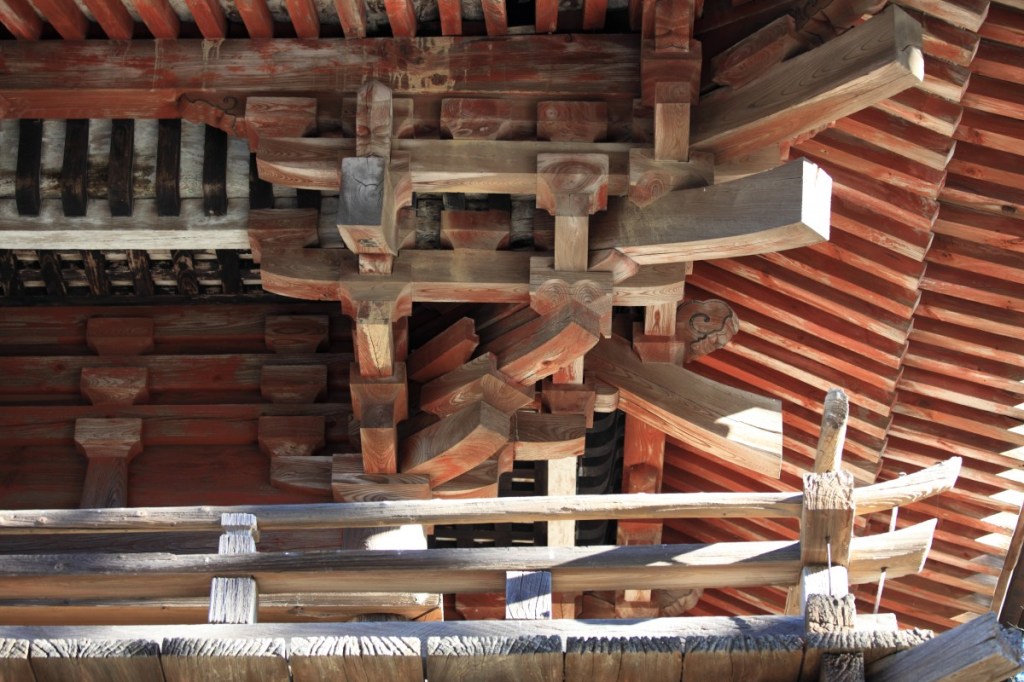
Below is my Prospectus Background section. Fair warning, it is long! I may have gone a bit overboard with the theoretical context but I was having too much fun writing the narrative of Japanese joinery.
Featured image credit: Tanaka Juuyoh
Context: What lenses am I looking through?
Japanese joinery is an art form which originated over 1,000 years ago. As a result, there exists a rich history of joinery typologies, applications, and surviving examples of them. What makes Japanese constructions unique are their exclusive usage of wood-to-wood connections. The traditional Japanese carpenter did not have access to glue, nails, or screws, so Japanese joinery relied on friction and geometry to make stable connections possible. As a consequence of this methodology, Japanese joints are readily disassembled, allowing for the replacement of components, without need for outright destruction (Sato).
Beyond this, the traditional carpenter also lacked access to the modern power tools that today expedite the woodworking process. As such, the carpentry was a highly skilled, time consuming, and respected discipline which held esteem in Japanese society, dissimilar to contemporaries in Europe for hundreds of years to come.
There are merely a handful of applications for joining wooden members: compression, tension, torsion, shearing, and bending. There are these five primary applications as a consequence of physics, but there are around thirty main Japanese joinery typologies with countless variations for any conceivable application. In this sense, Japanese joinery is equal parts an artform as it is a practical means to an end. They are applied in varying degrees in Buddhist temples, Shinto Shrines, and residential architecture, usually being specialized in their exigence; few joinery typologies are found in all three applications (Seike).
As an artform, Japanese joinery has evolved and become refined over hundreds of years into the highly disciplined form we have come to appreciate today, and it has allowed for the construction of remarkably resilient wooden structures. Many Japanese wooden constructions have stood for hundreds of years. Even with modern technology and materials, such a feat in an area prone to earthquakes, flooding, and storms is a daunting task, yet it has been achieved on multiple occasions in Japan.
In this background section, I will establish how it has been possible to construct such resilient wooden structures using Japanese Joinery. Beyond this, I will explain how the structural and qualitative aspects of Japanese joinery be exploited in a more modern context.
We will assess four main lenses through which to understand the form, history, uses, and application of Japanese joinery: tectonics, durability, the discipline, and disassembly. Along the way, I will use relevant literature and case studies to substantiate these qualities, to provide a foundational understanding of Japanese Joinery upon which I will be able to find new use cases for the artform.
Discipline: The art, the history, the craftsman
We must first understand the history and discipline of Japanese joinery and the traditional Japanese craftsman, in order to develop a necessary appreciation for the craft as a whole and an understanding of it as an artistic expression. Historically, the Japanese carpenter, or Daiku, was equal parts architect and engineer, as well as a craftsman and woodworker. He played a monumental role in shaping Japanese society through his work, practically and culturally speaking (Seike).
Iron tools were first used in the Yayoi period, 200BC-250AD, which unlocked a revolution in joinery and architectural capability in Japan. Now, mortises and tenons could be created, arguably the first element of Japanese joinery. From here, the typologies and capabilities exploded (Seike).
Methodologies, both their creation and execution, emerged as closely guarded family secrets, as family guilds of carpenters competed for prominence through innovation and refinement. The nature of these exclusive carpenter’s guilds maintained the high status of craftsmen in Japanese society, as the methods for the finest constructions were maintained in such secrecy (Seike).
Lastly, there is an appreciation for the process in the philosophy surrounding traditional Japanese joinery. The craftsman understands the process of making to be equally as important as the final product itself. There has existed little desire to expedite the process with modern conveniences like power tools, as the precision and quality of a master craftsman is unrivaled, particularly in the more culturally and aesthetically sensitive niche Japanese joinery exists in today. (Russel)
Tectonics: Typologies, use cases, structure
Why were wood to wood connections so prevalent in Japan? We know now of their effectiveness, but their longevity could not have always been known to people thousands of years ago. It was initially by chance that a scarcity of workable metals in Japan meant they could not be realistically used for construction, even if desired. Because of this, metals were used far more exclusively in weaponry, armor, and tools than what would be seen in Europe. The usage of metal products was taken so seriously that they even became the subject of control by imperial law (Gowland, William).
Unlike metal, wood is a renewable resource, which by comparison requires much less effort to collect and manipulate. After the introduction of tools made such sophisticated manipulations of wood as required by Japanese joinery possible, construction by wood to wood joinery exploded.
The four hundred-plus joinery methods can be categorized into two fundamental groups. The first is Tsugite, or the end-joints, where two components are joined end to end, in alignment. Think of extending a beam along its length. The other is Shiguchi, the angled or connecting joints. In Shiguchi, perpendicular or otherwise angled connections are made. The hundreds of joinery methods can each be classified as one of these two categories, independent of their application of compression, tension, torsion, shearing, or bending (Sato).
As Japanese architecture became more sophisticated, progressively more physically demanding and specialized structural applications emerged. Rather than an arrangement of plates and bolts holding any conceivable member together like in modern construction, an entirely specialized and novel joinery method emerged for these applications. Given the remarkable complexity of Japanese structures, particularly that of later Buddhist temples, it is clear why so many unique variations of joints have emerged.
Durability: Fastener corrosion, storm resistance, earthquake resistance, fire
Fastener corrosion is a serious concern for modern day joints, as the joint often relies entirely on the strength of a metal fastener, sheath, clamp, or bracket for their strength. Fastener corrosion is a consequence of moisture introduction in wood to metal connections, and can result in failure of a structural member. It is for this reason that it is perhaps lucky that the Japanese craftsman did not have access to nails, as corrosion of these elements would serve as a catalyst for the decomposition and subsequent destruction of Japanese structures. Thanks to their wood to wood connections, Japanese structures do not face these corrosion issues (Zelinka).
It can be hard for many to imagine wood as a stronger material than modern options such as concrete or steel, but comparing them directly is only half the story. When one considers strength by volume-weight, even a weaker wood species such as white cedar possesses a tensile strength four times greater than steel, and a compression resistance six times greater than concrete. While outright weaker than these modern materials directly, wood’s relative lack of weight for its strength proves more relevant in Japanese constructions (Seike).
These structures have survived countless earthquakes of varying magnitudes as well. Laying directly on the ring of fire, Japan sees around 1,500 earthquakes a year, accounting for 20% of the entire world’s earthquakes of a magnitude 6.0 or higher. With such great frequency, then, how have so many wooden towers survived for hundreds of years? This is again thanks to the wooden structure of pagodas. It is thought that the central mast or Shinbashira helps to absorb horizontal loads. Storms generating high winds also have failed to fell the towers, as they bend like the trees they are made of in the wind, without breaking. (Hanazato).
Horyu-Ji is considered the oldest surviving Japanese Temple. It was reconstructed over 1,300 years ago after being damaged by fire and has survived in this current form to this day. It is the world’s oldest wooden building, and the site includes a five-story building made entirely of timber joined with wooden connections (UNESCO).
While it may seem counterintuitive, wood constructions are actually fairly fire resistant, and able to remain structurally sound after burning. Wood degrades when exposed to high temperatures, even before combustion. Because wood is such a poor conductor of heat, however, it is possible for the surface of a wooden beam, for example, to burn and char over into non-combustible carbon while the core remains at a stable temperature, meaning recoverability of burned wooden structures is possible, and destruction is not inevitable (Ross).
Early Japanese constructions rarely suffered fire damage as a result of woods’ resilience, It was not until gas stoves and fireplaces entered a more densely packed urbanized fabric of wooden buildings that fires became a serious issue for wooden buildings. (Seike)
Disassembly: To deconstruct or to destroy? Disassembly vs Demolition
During the Yayoi period, Shinto shrine construction began. The Ise Grand Shrine is considered Shintoism’s most sacred shrine. It dates back to the third century, and has been ceremoniously deconstructed and reconstructed every 20 years by Shinto monks, taking breaks only in times of civil war. The techniques used are naturally very old, as the 20 year periodic reconstructions are quite faithful to the original as constructed in the third century. (Akima)
It is in the ceremonial disassembly and reassembly of the Ise Grand Shrine that we find a key aspect of Japanese joinery. Because no irreversible chemical or physical processes are used to assemble the Shinto shrines, they are easily disassembled and reassembled time and time again. Design which is capable of such a feat fosters the recycling of materials if a building is to be deconstructed permanently. It also, however, aids in longevity as damaged members can be replaced periodically without the need for radical demolition and entire reconstruction.
Modern constructions use many irreversible processes to join elements, like welding and gluing. As a consequence, deconstruction must instead become demolition, as the only way to take a building apart is to destroy it. Each element is more difficult to recycle, with many being impossible to do so. Designing for disassembly is an emerging design consideration that can learn from the tectonic lessons of Japanese joinery, particularly as seen in the Ise Shrine (Ciarimboli, Guy).
Image Citations (WIP)

Information Citations
Seike, Kiyoshi. The Art of Japanese Joinery. Weatherhill, 1990.
Sato, Hideo. The Complete Japanese Joinery. Hartley & Marks, 1995
AKIMA, Toshio. “The Origins of the Grand Shrine of Ise and the Cult of the Sun Goddess Amaterasu Ōmikami.” Japan Review, no. 4, 1993, pp. 141–98, http://www.jstor.org/stable/25790929. Accessed 18 Apr. 2022.
Russel, Stanley. An Architecture Tradition/A Craftsman’s Tradition: The Craftsman’s Role in Japanese Architecture – Acsa-Arch.org. https://www.acsa-arch.org/proceedings/Annual%20Meeting%20Proceedings/ACSA.AM.98/ACSA.AM.98.88.pdf.
Gowland, William. Metals and metal-working in old Japan. s.n, 1915, https://doi.org/10.5479/sil.347411.39088006282578
Ciarimboli, Nicholas. Guy, Brad. Design for Disassembly in the Built Environment: a Guide to Closed-Loop Design and Building. https://www.lifecyclebuilding.org/docs/DfDseattle.pdf.
Hanazato, Toshikazu, et al. “Analysis of Earthquake Resistance of … – IIT Kanpur.” 13th World Conference on Earthquake Engineering, https://www.iitk.ac.in/nicee/wcee/article/13_1223.pdf.
Zelinka, Samuel L. Corrosion of Metals in Wood Products. Intechopen, https://cdn.intechopen.com/pdfs/46241.pdf.
Ross, Robert J, et al. “Post-Fire Assessment of Structural Wood Members.” Forest Products Laboratory, https://www.fpl.fs.fed.us/documnts/pdf2005/fpl_2005_ross005.pdf.


 Myles Richter Design
Leave a reply to Jared Davenport Cancel reply