
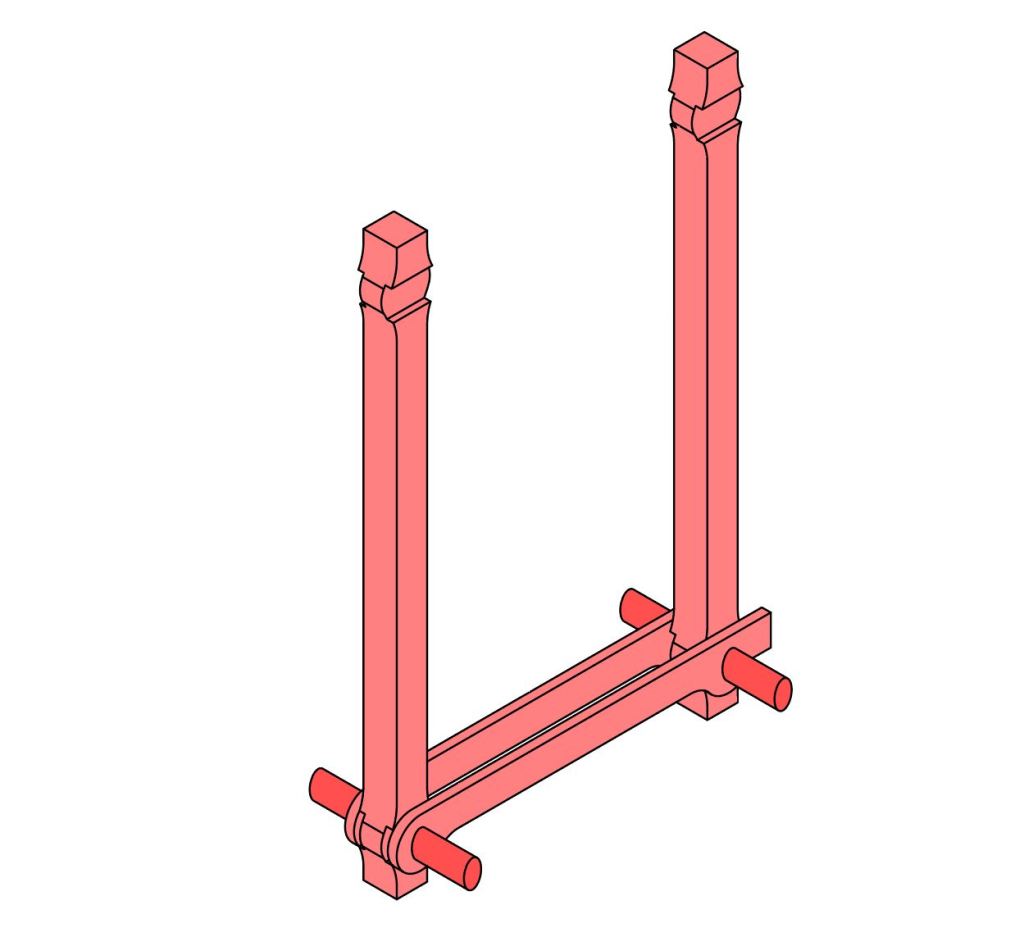
The time has come to narrow my selection down to one question. For my love of woodworking, and the greater breadth of resources available, I have chosen to advance with the question:
“Should traditional woodworking joinery techniques make a return in the architecture and construction industry?”
In this question, I plan to approach it from a few angles. The industry in many cases prioritizes speed, cost, and sustainability. What are the benefits and drawbacks regarding each of these? Next, what part of the industry does not necessarily prioritize these things, and what are the resultant opportunities here? How can this aid in construction, disassembly, and longevity? Lastly, how might Mass Timber and CNC Machining work to foster this return?
The next step is to compose a preliminary annotated bibliography, in which I look at currently available, relevant, academic sources, and assess their relevance to my topic. In doing so, I gain insight into the topic and figure out where gaps in understanding may exist for my Capstone to fill. My Annotated Bibliography is below, in the form of six sources and some notes.
Makki, Mohammed, et al. Bridging the Gap Between Traditional Japanese Fabrication and Advanced Digital Tools. SimAUD 2020, http://simaud.org/2020/proceedings/63.pdf.
This article provides a historical context surrounding traditional Japanese craftsmanship, and gradually looks towards their usefulness and future in the industry. From Pagodas to Gazebos, how can today’s digital tools recapture the elegance and sophistication of these timeless structures? This is highly applicable to my area of study, although it does not look at the use of CNC machinery, only CAD applications.
Shiran Magrisso Bezalel Academy of Arts and Design, et al. “Digital Joinery for Hybrid Carpentry: Proceedings of the 2018 CHI Conference on Human Factors in Computing Systems.” ACM Conferences, 1 Apr. 2018, https://dl.acm.org/doi/pdf/10.1145/3173574.3173741.
This article looks at the craft of various joinery techniques, from traditional to cutting-edge and entirely novel solutions. The paper looks at the ability of CAD and modern fabrication processes to create and implement new joinery solutions in furniture and structures. This in many ways fills a gap between the previous article and my topic of research, in how many joinery techniques could be recaptured and executed today.
Estateyieh, Isbah. FABRICATION OF COMPLEX FORMS IN THE DIGITAL AGE: RE-EXPERIENCING WOOD JOINERY IN ARCHITECTURE. https://dspace.gazi.edu.tr/bitstream/handle/20.500.12602/191682/?sequence=1.
While not an article, this Thesis is of a very similar nature to the question I am asking. The student looks at an approach for reapplying traditional building practices to the modern architecture rapport, and the practicalities of this reapplication. His speciality is in parametric, folding wood joinery, whereas mine would be regarding rigid, interlocking systems characteristic of Japan. Nonetheless, the approach and exigence is worth great note.
Adams, Cassandra. “Japan’s Ise Shrine and Its Thirteen-Hundred-Year-Old Reconstruction Tradition.” Journal of Architectural Education (1984-), vol. 52, no. 1, [Taylor & Francis, Ltd., Association of Collegiate Schools of Architecture, Inc.], 1998, pp. 49–60, http://www.jstor.org/stable/1425495.
This journal entry discusses the tradition of the Ise Shrine in Japan, a shrine which has undergone ceremonial “Shikinen Sengu” deconstruction and reconstruction in Japan for 1300 years. Every 20 years it is deconstructed and rebuilt by a group of Shinto monks and it remains stable and usable in the meantime. This entry provides insight into not only this tradition, but the techniques enabled by Japanese wood craft which enables it.
Seike, Kiyoshi. The Art of Japanese Joinery. Weatherhill, 1990.
REVIEW OF THIS BOOK:
Coaldrake, William H. Monumenta Nipponica, vol. 33, no. 4, Sophia University, 1978, pp. 495–96, https://doi.org/10.2307/2384362.
This book is a detailed guide to the history, craft, development, purposes, and implementations of various traditional Japanese joinery techniques throughout Japanese history. This would likely become an excellent source for information regarding which of these joints may be well suited to return in architecture today based on their strengths and weaknesses.
Tran, Jasmine. “Advancing Craft: A Translation to Modern Tectonics.” ResearchArchive Home, Victoria University of Wellington, 23 Sept. 2020, http://researcharchive.vuw.ac.nz/handle/10063/9208.
This is a thesis in which the author looks at the issue of the cost of well made joinery, and how it can be translated into modern prefabrication systems. Japanese joinery is recognized for its ability to resist damages of natural forces for hundreds of years. The usage of CNC routers and machine tool jigs are offered as a potential solution to this issue to foster the return of these techniques into the architectural meta.
 Myles Richter Design
Leave a comment